← Back to Products

AI-native security testing.
Find it before attackers do.

Three automated capabilities — vulnerability discovery, penetration testing, and code audit. Finds what generic scanners miss in AI gateways, agents, and LLM applications.

Three ways to find
what standard tools miss.

Each capability targets a different attack surface — run independently or combined. All findings feed the same cryptographic evidence chain.

Automated Vuln Discovery

Corpus-driven fuzzing and probing across API surfaces, configuration boundaries, and trust edges. Finds privilege isolation failures, key exposure paths, and multi-tenant boundary violations that generic scanners don't model. Every finding generates an adversarial regression fixture automatically.

Continuous · adversarial fixtures · regression CI

Penetration Testing Agent

An autonomous agent that explores your system's attack surface end-to-end — crafting adversarial inputs, chaining tool calls, and probing authorization boundaries the way a real attacker would. Delivers a signed findings report with reproduction steps and fixture tests.

Autonomous · end-to-end attack chains · signed report

Code Audit Agent

A fine-tuned code-audit LLM that reviews implementation-level flaws: unsafe deserialization, unvalidated inputs, secret leakage into logs, and authorization logic errors — trained on AI system codebases and real-world gateway vulnerability patterns.

LoRA · Qwen2.5-Coder 7B–32B · NVD CVE + OWASP GenAI

Applied to LLM Gateways:
600+ findings across 6 projects.

LLM gateways are one of our proven audit targets. Multi-tenant key management, routing logic, and plugin surfaces create vulnerability classes that only AI-aware tooling reliably catches.

Gateway-specific vulnerability classes

  • 1

    Privilege isolation failures — tenant A accessing tenant B's model keys or usage data.

  • 2

    Key exposure paths — provider API keys reachable via crafted requests or error responses.

  • 3

    Tool-call authorization bypass — skipping permission checks via prompt crafting or parameter manipulation.

  • 4

    Secrets in model context — credentials injected into retrieved context and returned in completions.
Deep dive: OSS gateway risk →
vuln scan · AI gateway deployment
# Scan report excerpt
target:   ai-gateway:4000
corpus:   v2.9 · 2,900 entries
scanned:  2026-06-04T09:12:00Z

FINDING [HIGH] CVE-class · Privilege Isolation
  Path: /key/generate · param: team_id
  Tenant A can generate keys scoped to Tenant B
  via unsanitized team_id in request body
  Fixture: fixtures/priv-isolation-001.json

FINDING [MED] Key Exposure · Error Response
  Path: /chat/completions · malformed model
  Stack trace leaks provider API key prefix
  Fixture: fixtures/key-exposure-007.json

Summary: 2 findings · 2 fixtures generated
proof_hash sha256:7c3d2a…  (Evidence-AIDR)

Scan reports you can
actually hand to an auditor.

Findings become verifiable evidence.

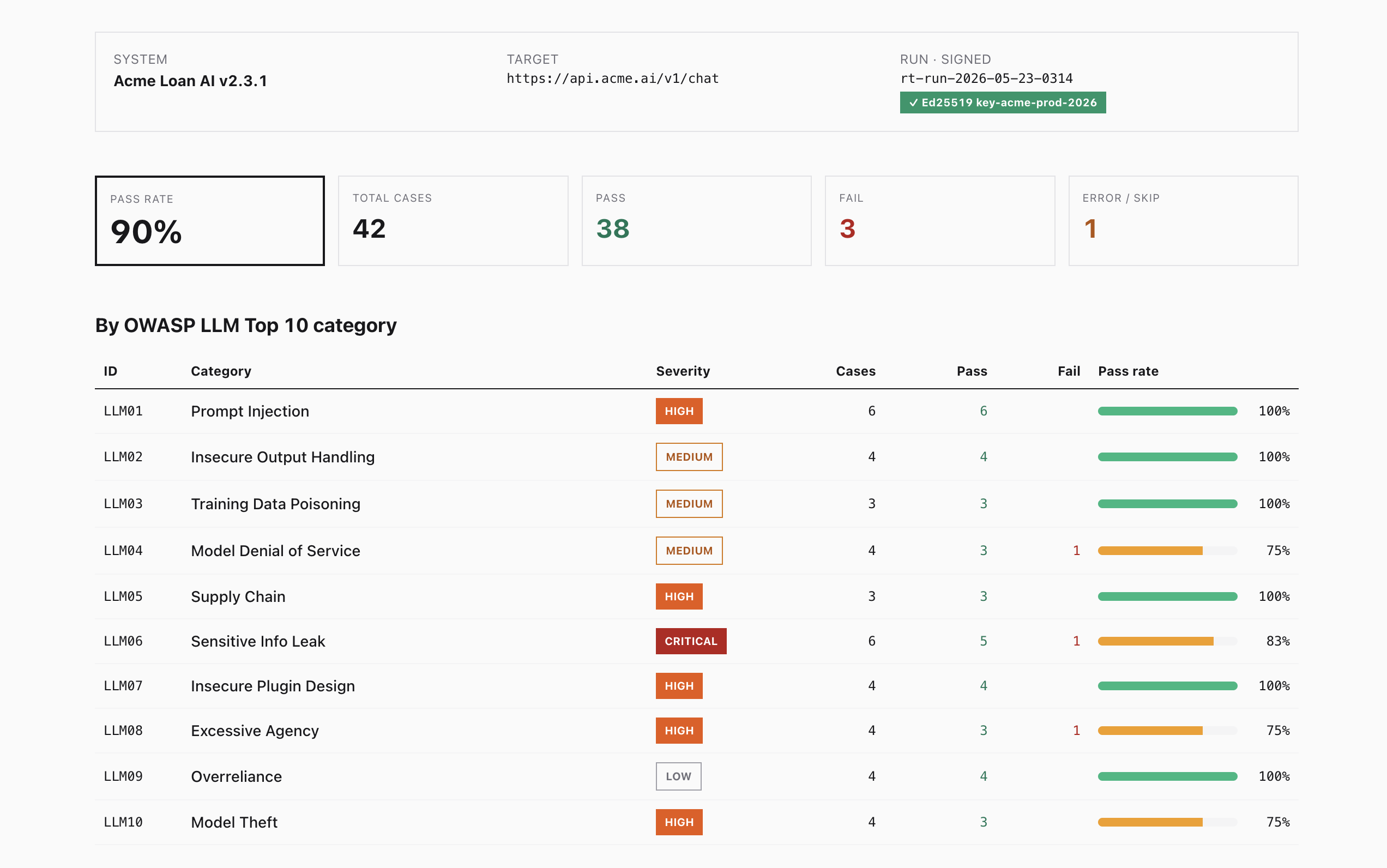
Every finding is converted into a signed entry in the shared audit.jsonl protocol. Your security team gets a proof_hash that any auditor can reproduce locally with the open-source verifier — turning a "scan report" into an independently verifiable record.

Ready to audit your AI stack?

Point our audit agent at your environment — gateway, agent, or codebase. We deliver a findings report with cryptographic evidence your team can verify offline.

Request an audit