Turn AI runtime activity into independently verifiable audit evidence.
Why it matters
AI agents execute real actions. Security tools stop at logs. None of it can be independently verified.
No cryptographic record proves agent actions happened as intended.
SOC 2, ISO 42001, and the EU AI Act require evidence a third party can independently verify.
One misconfigured integration or tool can expose your AI stack to privilege escalation and data leakage.
Our approach
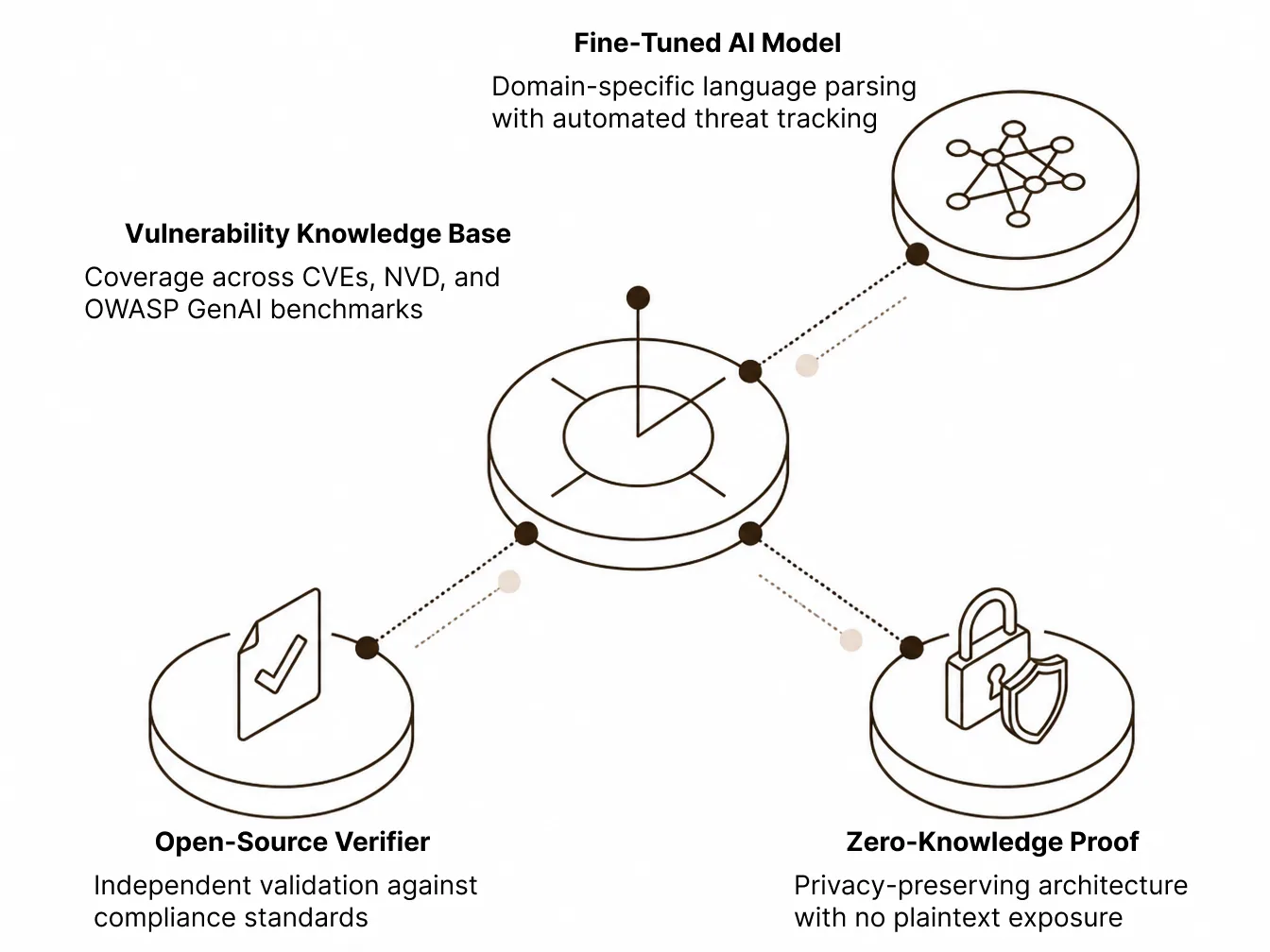
The evidence layer for your AI runtime — on top of existing gateways, producing tamper-evident bundles any auditor can verify offline.
Cryptographic signature chain any auditor can replay locally — offline, no vendor account.
Raw prompts never leave your VPC. Tracestone holds only ciphertext and signed evidence.
Apache 2.0 verifier. Run offline — no account, no NDA, no Tracestone dependency.
What we build
Each addresses a different layer of AI risk — independently or together.
01
Find vulnerabilities in your AI applications before attackers do. Uncover security gaps across prompts, workflows, integrations, and runtime behavior.
Black-box testing · white-box audit · AI application security
Learn more →02
Pre-deployment security analysis for AI agents. Audit code, tool configurations, and permission models before your agent goes live.
Prompt injection detection · privilege escalation · tool-call audit · multi-agent trust chain
Learn more →03
Post-deployment monitoring and audit for AI agents. Detect attacks, intercept dangerous actions, and seal every event as tamper-evident evidence.
Runtime monitoring · attack detection · audit evidence · SOC 2 · ISO 42001
Learn more →